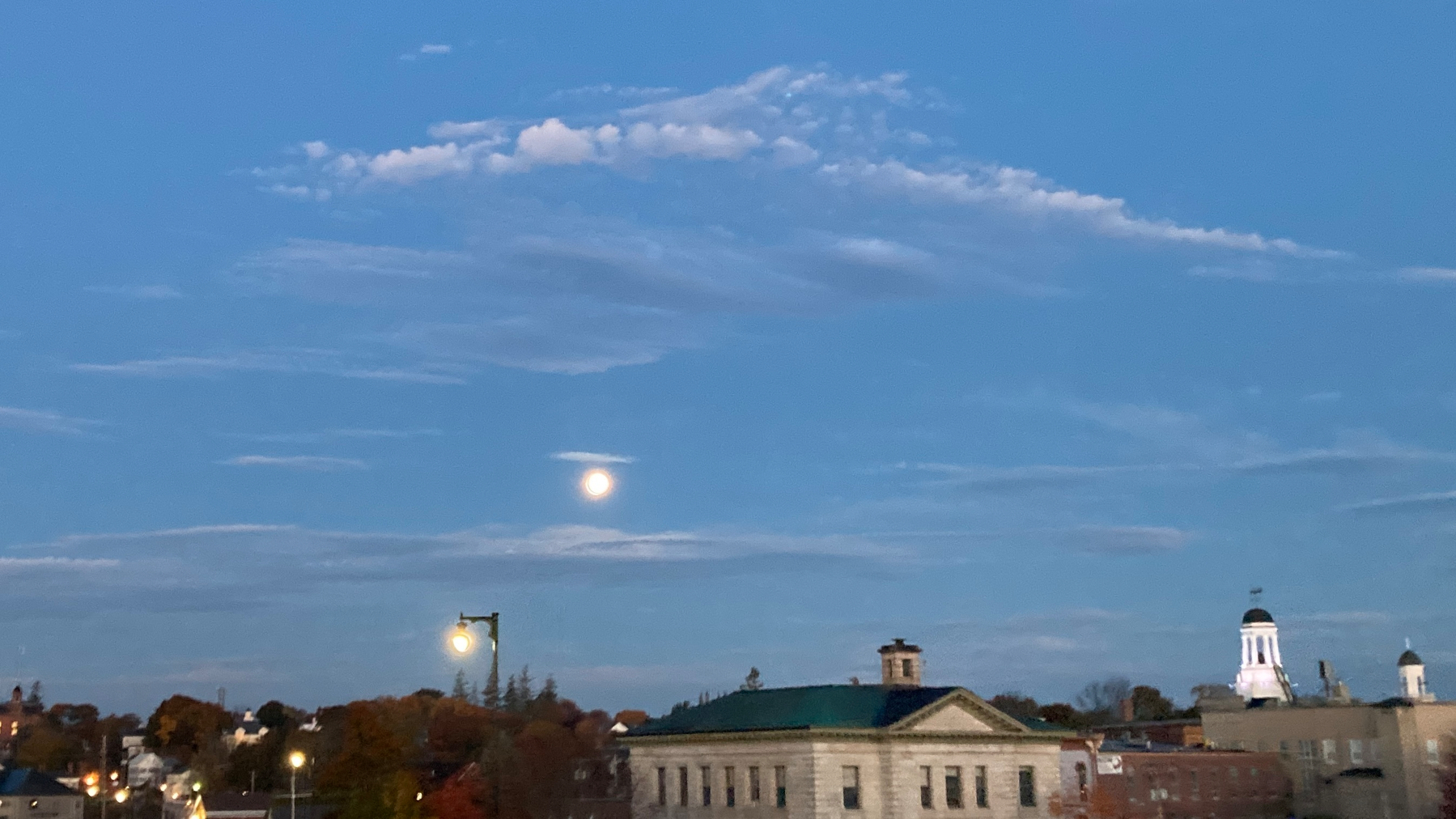
This morning’s waning hunter moon over the city of Bath
It has long made perfect sense to me that a picture taken on an iPhone would either use its wizardry to make the thing in front of you look “better“ than it really does, or it would do no justice whatsoever to the thing in front of you at all. Rightly or wrongly you may justify it, but them’s yur options. (It’s true of photography in general, but the iPhone has a special way of taking less problematic functions of technology and simultaneously masking and magnifying them.)
It somehow fits, too, with Maine’s (chosen or fated) way of life. Just this morning I learned — with not an ounce of surprise, mind you — that Maine is leading the charge with the highest percentage of second (“seasonal”) homes in the country. There’s some “polar star” irony there that does sting a little as it, uh, slaps you in the face, but you get used it, I guess. (It’s a fact, too, that I’m soon to accept some defeat over, the instruments of surrender being worked out and drafted over the coming months. More on that another time.)
But I’m not the only one who thinks about this stuff this time of year; it’s a theme deeply rooted in Maine itself. I’ve quoted before but never posted this excerpt from the introduction to the 1998 reprint of Night Train at Wiscassett Station, about the writer Lew Dietz:
He understood the importance of the seasons. To this day Mainers generally don’t have as much pavement separating them from the earth as residents elsewhere. Snowstorms are still largely respected in Maine—neither feared as cataclysmic, nor ignored as nuisances. Summer is perceived as the anomaly that it is, a hectic blip on the radar screen of the year, not to be mistaken as ’the way life should be.’ Who residing anywhere on the coast or up in the woods has not felt the palpable sense of relief that washes over the state once the leaves have fallen? ‘By the time of October’s hunter moon,’ Lew wrote, ‘the trauma of summer has been healed, health and sanity restored.’”
If you want as close to a sense of Maine as you can possibly get from a book — one that I believe does as much justice to the art of photography and writing as anything can — I recommend finding a copy. (And now I recall that I shared about this once before, a couple years ago , along with one of my favorite of Kosti Ruohomaa’s photos and a reference to Richard Wilbur here.